
A freight railroad does not have to own every mile of track its traffic uses. With trackage rights, one railroad operates its trains over another railroad’s tracks. With haulage, one railroad arranges for the other to perform the movement over the latter’s tracks. The operating railroad changes; the line on the map may look much the same.
That distinction is useful, but it leaves several questions unanswered. Which traffic can move? Between which points? Can the visiting railroad serve a factory along the way, or only pass it? Who has committed to the service the customer expects? A route can be physically connected and commercially unavailable for a particular shipment.
A 2005 Congressional Research Service glossary, reproduced by EveryCRSReport, supplies the basic operating distinction. Its haulage definition specifies the other railroad’s crews and usually its locomotives. That last word matters: equipment ownership is not a reliable shortcut to the whole arrangement. The glossary explains terminology; the actual grant and governing documents establish the rights.
Who operates the movement?
Trackage rights and haulage can both help traffic cross the boundary between two railroad networks. They accomplish that in different ways. Under the trackage-rights model, the visiting railroad runs its train over the specified track. Under haulage, the railroad performing the haul moves the other railroad’s cars or train under the arrangement.
The customer’s commercial relationship and the physical movement therefore need separate descriptions. A railroad’s name on a service proposal does not establish that its employees will operate every part of the journey. Conversely, seeing another railroad’s locomotive does not settle who contracted with the customer, what traffic is eligible or what price applies.
| Arrangement | Operating distinction | Still to establish |
|---|---|---|
| Trackage rights | The visiting railroad operates its trains over specified track belonging to another railroad. | Permitted traffic and locations, operating arrangements, compensation and service terms. |
| Haulage | The other railroad performs the agreed movement. The CRS description uses its crews and usually its locomotives. | The covered movement, equipment arrangements, commercial terms and service obligations. |
| Switching arrangement | In the CRS terminology, one carrier transports a competing carrier’s railcars at origin or destination for a fee. | The pickup or delivery service and handoff point. A switching arrangement does not, by its label alone, establish corridor-wide running rights for the other railroad. |
Ownership belongs in another column. Neither “trackage rights” nor “haulage” is enough to conclude that the underlying railroad has been sold. Nor does the label tell you who manages the infrastructure. A 1998 transaction described below involved a track owner, an operator acting as its agent, and a third railroad obtaining rights to run trains. Three roles, one stretch of track.
Passing a factory is not serving it
A right to travel from one endpoint to another can be quite narrow. In a 1998 Surface Transportation Board notice, Conrail, as owner, and Indiana Harbor Belt, as operator, agreed to grant CSX Transportation overhead trackage rights over approximately 4.8 miles of the Kankakee Line in Indiana. The notice described CSXT operating its trains and equipment with its own crews.
The grant was restricted to bridge traffic between the specified endpoints for trainload movements of finished automobiles and associated empty equipment to and from the Ford Mixing Center in the Calumet Yard area. It was not a general invitation to collect business at every location along the line.
This is the practical difference between a route and a market. A railroad can have permission to cross a segment without having permission to serve every customer beside it. If the business case depends on access to a particular plant, the plant’s eligibility is a question to answer from the grant—not from the fact that the train goes past its fence.
A different historical example makes the location-specific purpose clearer. A March 2020 Board decision published in the Federal Register described BNSF’s local trackage rights over Union Pacific lines for loaded and empty ballast trains to and from the ballast pit at Elsey, California. The introductory account cited BNSF’s verified notice; the Board’s own reasoning also identified the limited maintenance-of-way purpose. That example establishes a particular local movement, not a universal definition of what every local-rights agreement permits.
One corridor, different permissions
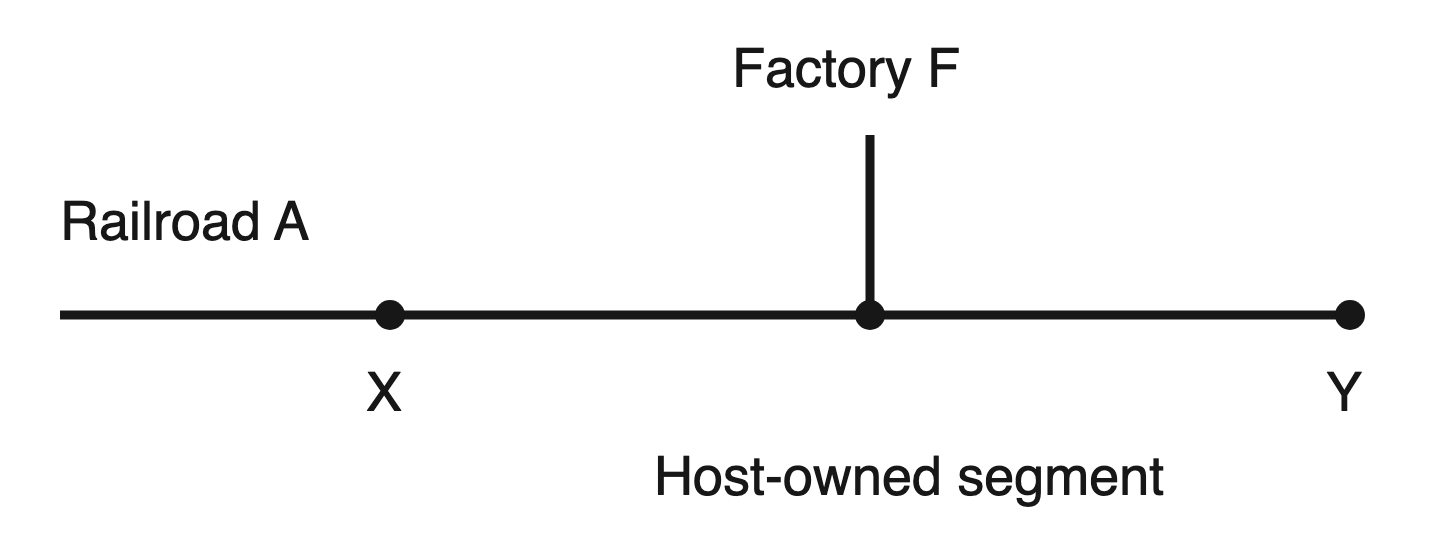
Consider a hypothetical corridor. Host owns the track from X to Y. Factory F connects to that segment, and Railroad A connects to Host at X. Those physical connections are assumptions for the illustration. They do not supply any operating or commercial rights.
Suppose A receives a grant expressly limited to carrying specified bridge traffic between X and Y, with no service at F. A can operate the permitted through movement under the assumed terms. It cannot treat F as an additional customer merely because the train passes the connection.
Change the arrangement to haulage. Host now performs the specified movement for A under their contract. A may have a commercial role in the service, but the precise relationship with the shipper, the equipment arrangements and the service commitments still need to be read. The word “haulage” does not fill those blanks.
Now assume the parties expressly add permission for A to pick up and deliver eligible traffic at F. That changes the assumed scope. It is the added permission—not a more colorful route map—that answers the factory’s access question.
Switching offers another possible description of the origin or destination leg. In a hypothetical switching arrangement, Host moves F’s cars to the agreed handoff with A. That is a service performed for the connecting movement; it should not be silently converted into permission for A to operate trains everywhere on Host’s corridor. Identify the actual handling and handoff before deciding which arrangement is being described.
The Gulf grain case turns on the words
The Board’s decision served July 7, 2025, in the Union Pacific–Missouri-Kansas-Texas proceedings shows why the particular terms matter. The dispute concerned Kansas City Southern Railway Company, or KCSR, and rights originating in a 1988 agreement associated with the UP–MKT merger. It was a decision about those rights, not a new industry-wide access program.
The 1988 arrangement included “North End” rights connected to grain movements toward Kansas City. KCSR’s network at that time did not reach the ports of Houston and Galveston. The agreement therefore also included “South End” haulage rights, convertible to trackage rights, over UP track between Beaumont and those ports for certain grain traffic. The conversion feature belonged to this arrangement; it is not a general feature to assume in every haulage contract.
After the 2023 Canadian Pacific–Kansas City Southern combination, a dispute arose over grain originating on Canadian Pacific’s network and reaching KCSR at Kansas City. Could that traffic continue to use the South End rights now that the carriers were under common control? The answer depended in part on what the agreement meant by traffic “interchanged” to KCS at Kansas City.
There were two important questions in the 2025 decision. First, was the disputed term sheet a merger condition the Board would interpret and enforce, or was this a private-contract dispute for another forum? The majority concluded that the ICC, the Board’s predecessor, had imposed the entire term sheet as a merger condition. It therefore addressed the dispute. That conclusion does not mean the Board decides every disagreement under a private railroad contract.
Second, what counted as interchange under this term sheet? The majority read the term to encompass a railcar’s transfer from one carrier’s account to another’s, including transfers between separate carriers under common control. It granted KCSR’s petition and determined that the specified grain traffic received from CP’s operating affiliates at Kansas City could use the South End rights.
Board Member Primus agreed that the Board was the appropriate forum but dissented on the traffic question. His reading emphasized that the term sheet’s definition of “KCS” included subsidiaries and affiliates. In his view, the affiliate-origin traffic was already within that defined group and therefore was not being interchanged to it in the required sense. That was the dissent’s interpretation, not the ordered result.
The distinction between the operating company, the agreement’s defined party and the combined corporate group was doing real work. A reader who treats every company name as interchangeable misses the dispute. A reader who calls the decision simply “permission to use UP track” misses the traffic restriction.
The 2025 order supports a bounded conclusion about the rights at issue. It does not measure today’s rates, transit times or shipping volumes. Commercial access can be valuable without the legal decision itself proving how much money a shipper saved or how reliably a train subsequently arrived.
Read the service promise separately
Once the operating arrangement is clear, connect it to the actual shipment. An agreement covering one commodity, origin or destination may not answer a proposal involving another. A right to move traffic through a segment may not answer who will place cars at the customer’s facility. A commercial offering may depend on a handoff that needs its own arrangements.
Start with the parts of the proposed journey that could change the answer:
- Traffic and geography: identify the permitted commodities, origins, destinations, endpoints and any named customers or facilities.
- Physical operation: identify the carrier performing each leg and the documents governing its use of the track and equipment.
- Pickup, delivery and interchange: establish who handles cars at the facility and where responsibility passes between carriers.
- Service commitments: find the actual terms for the promised movement, including any relevant scheduling or performance provisions. Do not infer timetable priority from the label on the arrangement.
- Commercial terms: distinguish the shipper’s transportation price from compensation between railroads and any separately applicable charges.
These questions are a way to read a proposal, not a set of answers supplied by the word “access.” The sources above demonstrate particular permissions. They do not establish that every visiting train receives a guaranteed path, that every host provides the same service or that a quoted route is available for every load.
If the issue later becomes a charge for holding cars, placement, free time and release are a different inquiry. The railcar demurrage guide follows that billing timeline. It should not be used to decide whether the underlying route or customer service was authorized.
Duration is another part of the grant
The 2020 Elsey decision also illustrates a distinction worth retaining in a business review: the parties’ agreed duration and the regulatory treatment of expiration were separate questions in that proceeding. The Board granted partial revocation so the specified rights could expire at the end of 2020 under the decision’s terms.
That is a dated example, not a filing procedure to reuse today. For an actual arrangement, identify the contract term, amendments, termination provisions and relevant operating authority. If a merger condition is involved, identify that condition too. A short summary saying “expires next year” may omit the document or decision that determines what happens next.
The result should be an explainable journey: this carrier performs this movement, on this track, for this traffic, with these pickup and handoff permissions and these service terms. Factory F needs that answer. The train passing its fence is only the beginning of the conversation.
Explore Infinite Upside
For Vijay Sheth’s personal accounts, read Infinite Upside: Building Wealth With Room to Live, published by Sheth Capital, Inc.
Read the railcar demurrage guide
How to Review a Railcar Demurrage Invoice